What AI Gets Wrong About Creativity
AI is great at producing competent first thoughts. Here's why that's not enough.

17 years ago, I experienced a breakthrough.
It happened in a library. But not the kind of library you’re imagining.
Yes, this library had bookshelves, tables and a stern librarian, but that’s where the normalcy ended. There were also mechanical bulls, exercise bikes designed to shoot tennis balls at riders’ faces, and a diabolical contraption called a “Slapping Machine” that would hit you with a spinning rubber glove if you came too close.
This wasn’t a fever dream - it was the set of MTV’s Silent Library.
The rules of the show were simple. In each episode, six contestants - always a group of friends - sat around a library table and dealt playing cards. Whoever drew the unlucky card would have to endure a bizarre challenge, and if they completed the challenge without laughing or screaming too loudly - because shh, it’s a library - their team would win cash.
If you’re having trouble picturing all this, I proudly present a full episode, starring Jimmy Fallon and The Roots.
(You’re welcome.)
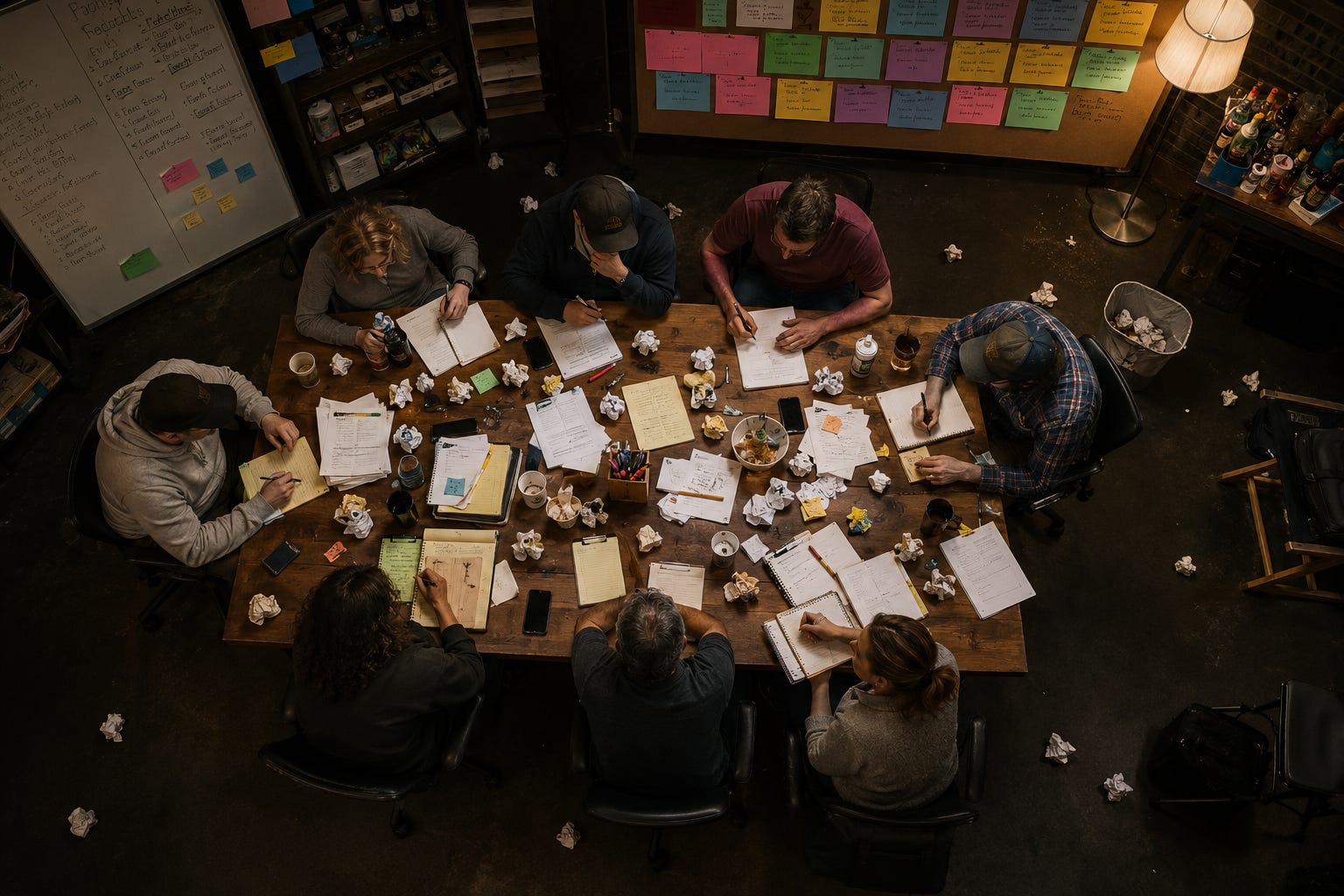
In 2009, this acid trip of a TV show was greenlit for 20 episodes, and I was hired as Head Writer and Supervising Producer - tasked with generating hundreds of challenge ideas in a matter of weeks with the help of six (mostly stoned) writers. After several fruitless brainstorms, I switched to a different model of idea generation: Each day, every writer had to generate at least 10 original challenges.
Not 8, not 9 - at least 10.
At first, I wasn’t sure the plan would work. When each writer submitted their daily list, it was fairly obvious which ideas were mailed in near the end of the day. The 8, 9 and 10 ideas were always the crazier ones, sometimes the least realistic. They were also the ideas nobody would’ve pitched in a normal brainstorm, because they sounded too weird, or too impossible.
But when we started filming the season, I quickly realized something surprising: the show’s funniest moments almost never came from the expected ideas. They came after the obvious ones were exhausted. Once the writers burned through the safe pitches, they started making stranger, more innovative connections, taking bigger swings and pitching ideas they normally would’ve self-censored before saying out loud. And that’s where the magic lived.
Your job probably doesn’t involve mechanical bulls or slapping machines. But I’ve watched the same thing happen in corporate brainstorms, strategy offsites, and creative workshops - the room declares itself tapped out, and then, somewhere in the silence that follows, the winning idea surfaces. The one nobody would’ve whispered just minutes earlier.
In the age of AI, that 10-ideas-per-day mandate might sound like a quaint relic from a forgotten time. After all, ChatGPT can generate 10 ideas in seconds, who needs an entire day? I’ll admit having this thought when I first started wrapping my head around what AI is capable of doing. But with each workshop I run, the truth becomes clearer: To achieve real innovation in your business, you need to strike the right balance between what AI can do for you and what you must do for yourself.
It’s tempting, and easy, to outsource your idea generation to the AI app of your choice. And honestly, I recommend starting there. Asking Claude or GPT to generate an initial list is a smart move. AI is incredibly good at producing competent first thoughts. But handing the entire process to the machine means skipping a critical stage - the part where your brain is forced past the obvious answers.
Because true creativity usually doesn’t happen on your first thought. Or your second. It often happens around idea number eight, when the polished answers are gone and your brain starts making unexpected connections instead.
The danger isn’t that AI will replace human creativity. The danger is that humans will stop pushing themselves far enough to reach it - settling for the best idea AI could generate instead of the better one that was still a few uncomfortable minutes away.
Looking back, my breakthrough wasn’t just about generating more ideas. It was about what happens when you can’t stop at eight. The quota was the whole point.
Use AI to get to the starting line faster. But to cross the finish line, you’re going to need more. And that more needs to come from you.
Didn't Impractical Jokers do a Silent Library challenge years ago?